Introduction
Reflex sights are compact optical devices designed to provide a visible aiming reference without the traditional sight picture associated with conventional iron sights. They are widely used across different sporting and recreational equipment categories, including compatible airsoft, paintball, crossbow, and other applications where the manufacturer and local rules permit their use.
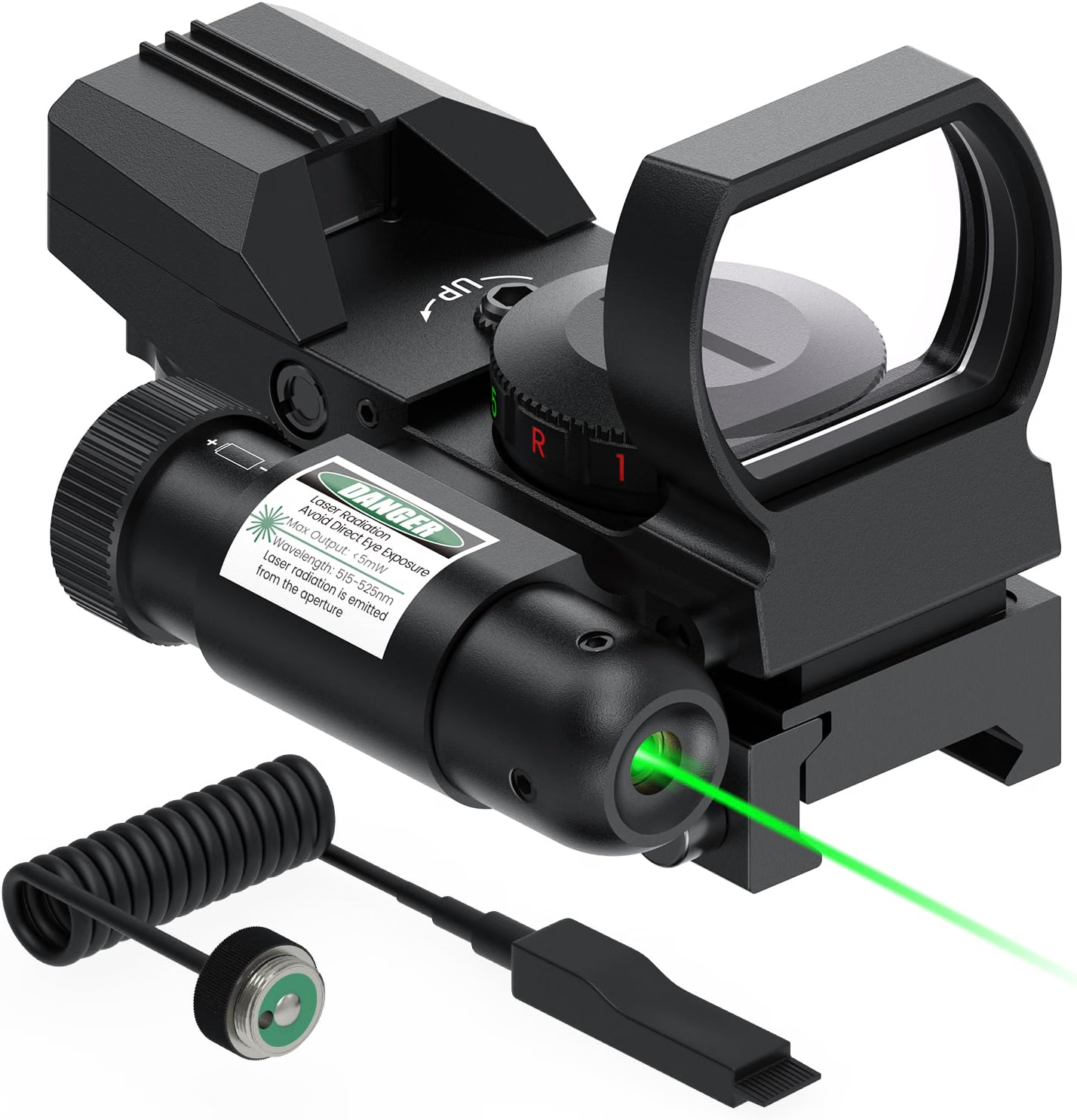
The Feyachi RSL-88 Reflex Sight is a compact electronic reflex sight that combines several selectable reticle patterns with red and green illumination and an integrated green laser. The manufacturer describes the RSL-88 as offering four reticle modes, two illumination colors, and five brightness levels for each color. It also uses an aluminum-alloy body and an integrated mount intended for standard Picatinny rails.
The integrated laser makes this design different from a conventional reflex sight. Instead of treating the optical reticle and laser as completely separate accessories, the RSL-88 combines them into one housing. Product documentation identifies the laser as a Class IIIA green laser with an output below 5 mW.
There are several concepts worth understanding before evaluating a sight of this type. A reflex sight’s reticle is electronic and battery-powered, while a laser creates a separate projected point. Multiple reticle patterns provide visual choices, but they do not automatically make a sight more accurate. Similarly, brightness settings can help with visibility in different lighting environments, but the appropriate setting depends on the surroundings and the user’s vision.
This guide examines the RSL-88 from an educational perspective, focusing on its design, optical concepts, general compatibility, maintenance, laser safety, and the differences between common sight categories. It does not provide instructions for using a firearm or optimizing a weapon for accuracy.
Key Features
Four Reticle Patterns
One of the defining characteristics of the RSL-88 is its selection of four reticle patterns.
The manufacturer describes four selectable patterns, allowing the user to choose a visual reference that fits the intended application and personal preference.
A reticle is the visual marking displayed within an optical sight. In a basic red-dot sight, the reticle may simply be a dot. Other designs can include combinations of dots, circles, crosses, or other geometric shapes.
Different reticle shapes can change how much visual information appears inside the viewing area.
A simple dot generally creates a minimal visual reference.
A more complex reticle can provide additional geometry, but it may also occupy more of the user’s field of view.
The presence of four patterns therefore provides flexibility rather than a guarantee of superior performance.
Red and Green Illumination
The RSL-88 provides both red and green illumination options.
The manufacturer specifies five brightness levels for each color.
Color selection can be useful because the perceived contrast of an illuminated reticle can change depending on the surrounding environment.
For example, a particular reticle color may appear more noticeable against one background than another.
Brightness has a similar relationship with ambient lighting.
A very low setting may be difficult to see in bright daylight, while an unnecessarily bright setting can make the reticle appear less comfortable against a darker background.
The useful concept is therefore adjustability rather than simply choosing the highest brightness.
Integrated Green Laser
The RSL-88 incorporates a green laser into the overall sight assembly.
According to Feyachi’s specifications, the laser is a Class IIIA device with an output below 5 mW.
The laser is separate from the electronic reticle.
The reflex sight displays a reticle within the optical viewing area.
The laser projects a beam outward and creates a visible point where the beam intersects a surface.
These are two different technologies even though they are integrated into the same product.
Because the RSL-88 contains a laser, appropriate laser safety is particularly important. The beam should never be directed toward people’s eyes, aircraft, vehicles, or other locations where laser exposure could create a hazard. The product documentation specifically warns against direct eye exposure.
Five Brightness Levels
Each reticle color is described as having five brightness settings.
This provides a range between a relatively subdued visual reference and a brighter illuminated reticle.
Brightness adjustment can be particularly useful when moving between different environments.
For example, a setting that appears comfortable indoors may not provide enough contrast outdoors in bright conditions.
Conversely, an extremely bright reticle can become visually distracting in darker surroundings.
The goal is normally to select a setting that provides clear visibility without unnecessarily overwhelming the viewing area.
1x Magnification
The RSL-88 is described as a 1x reflex sight. Product documentation lists a 33 mm objective aperture and a field of view of approximately 15.8 degrees at 100 meters.
A 1x sight does not magnify the scene like a traditional riflescope.
Instead, the viewer sees the surrounding scene at approximately its normal scale while the illuminated reticle is superimposed within the optical window.
This is one of the defining characteristics of reflex sights.
Unlimited Eye Relief
Product documentation identifies the RSL-88 as having unlimited eye relief.
In practical optical terms, unlimited eye relief means the user does not need to position the eye at one narrowly defined distance behind the optic to see the complete sight picture.
This differs from many magnified scopes, where eye position can significantly affect the visible image.
Even with a reflex sight, however, consistent head and equipment positioning remain useful for maintaining a predictable viewing experience.
Picatinny Mount
The RSL-88 uses an integrated mount intended for standard Picatinny rails. Feyachi describes the mounting system as a 20 mm mount.
Picatinny is a standardized rail interface used for mounting a variety of accessories.
The presence of a Picatinny mount does not mean that every piece of equipment with a rail-like appearance will be compatible.
Users should verify the actual mounting standard on their equipment before installation.
Aluminum-Alloy Housing
The manufacturer identifies aluminum alloy as the primary housing material and describes an anodized finish.
Aluminum is commonly used in compact optical accessories because it provides a relatively rigid structure without the weight of some alternative metals.
The manufacturer’s specifications also describe the RSL-88 as waterproof, fog-resistant, shock-resistant, and corrosion-resistant.
Such descriptions should be understood within the manufacturer’s stated operating conditions. No compact electronic optic should be assumed to be immune to damage from severe impacts, prolonged water exposure, or improper maintenance.
Pressure Switch
The listed package includes a pressure switch associated with the integrated laser. Feyachi identifies the green laser sight and pressure switch among the included components.
A pressure switch is an external control that can be used to activate an attached electronic accessory without reaching directly for its housing controls.
Because this product contains a laser, users should treat the switch as a control for a potentially hazardous light source and follow the supplied safety instructions.
Understanding Reflex Sight Technology
A reflex sight uses a transparent optical element to display an illuminated reticle in the user’s field of view.
Unlike a conventional scope, it generally does not magnify the target.
The electronic system creates the reticle.
The optical window allows the user to see the surrounding scene while the illuminated pattern appears superimposed within the viewing area.
This creates a fundamentally different sight picture from a traditional iron sight.
How the Reticle Appears
The illuminated reticle is generated inside the sight rather than physically painted onto the target.
When the optic is viewed normally, the reticle appears to be positioned relative to the scene.
This is why the sight can provide a visible reference while maintaining a broad view of the surroundings.
Why 1x Matters
A 1x optic is useful when magnification is not required.
The surrounding scene remains approximately the same scale as normal vision.
This makes a 1x reflex sight conceptually different from a magnified scope designed to enlarge distant objects.
How It Can Be Used
The RSL-88 is a weapon-related accessory, so safe and lawful use is essential. The following examples describe general categories rather than providing operational or aiming instructions.
Compatible Sporting Equipment
A compact reflex sight can be used as an optical accessory on compatible sporting equipment where the mounting system and local rules permit it.
Before use, the equipment manufacturer should be consulted to verify compatibility.
Airsoft
Reflex sights are common accessories in airsoft.
A 1x optic can provide an illuminated visual reference without the magnification associated with a conventional scope.
Airsoft users should ensure that the sight is compatible with the specific rail and that the equipment is used according to field rules.
Paintball
Some paintball equipment supports accessory rails.
Where a compatible Picatinny interface exists, a compact reflex sight may be used as an accessory when permitted by the manufacturer and field rules.
Crossbow Equipment
Some crossbow systems provide accessory mounting rails.
Whether a particular reflex sight is appropriate depends on the crossbow’s mounting system, manufacturer specifications, and local regulations.
The sight should not be assumed to be compatible with every crossbow simply because both products use the word “rail.”
Recreational Target Equipment
Some recreational equipment platforms may support compact optical accessories.
The same principle applies: the accessory must be mechanically compatible, and its use must comply with the rules governing the activity.
General Optics Familiarization
The RSL-88 can also be understood as an example of modern reflex-sight technology.
Users interested in optics can study the differences between red and green illumination, reticle geometry, brightness adjustment, optical windows, and laser technology without relying on the sight for any particular operational application.
Who It May Be Suitable For
Users Interested in Compact Reflex Optics
The RSL-88 combines a compact 1x reflex sight with an integrated laser.
It may therefore be relevant to people looking for an all-in-one optical accessory rather than separate components.
Users Who Prefer Reticle Choices
Four reticle patterns provide more visual options than a single-pattern sight.
This can be useful for people who want to experiment with different reticle geometries.
Users Who Prefer Red or Green Illumination
The ability to select between red and green provides another level of visual customization.
The more important consideration is whether the chosen color provides comfortable contrast in the user’s normal environment.
Users With Compatible Picatinny Rails
The integrated mount is intended for standard Picatinny rails.
This makes rail compatibility an important prerequisite.
Recreational Users
The product can be relevant to lawful recreational applications such as airsoft and other activities where electronic optics and lasers are permitted.
Important Things to Consider
Laser Safety Is Different From Reticle Safety
The illuminated reticle is viewed through the optic.
The laser projects light into the environment.
That distinction is extremely important.
The RSL-88’s laser is identified as Class IIIA and below 5 mW.
Even relatively low-power visible lasers should never be intentionally directed toward someone’s eyes.
They should also never be aimed toward aircraft or other situations where the beam could create a safety hazard.
Check Local Laws
Laser devices and weapon-mounted accessories can be regulated differently depending on the jurisdiction.
The same applies to hunting, firearms, airsoft, paintball, and crossbow equipment.
Before using the product, users should check the laws and regulations that apply to their location and activity.
Verify the Rail Standard
Picatinny rails and other mounting systems are not automatically interchangeable.
A sight designed for a Picatinny rail should be installed only on a compatible mounting surface.
If an adapter is required, it should be an appropriate component designed for the relevant standards.
Batteries Are Essential
Unlike passive iron sights, the RSL-88 depends on batteries for its electronic features.
The reflex reticle requires electrical power.
The laser also has its own power requirements.
Product documentation identifies separate battery systems for the sight and laser.
This means battery condition should be considered part of normal maintenance.
Battery Storage
Electronic optics can consume batteries even when stored improperly or left switched on.
Users should follow the manufacturer’s recommendations for long-term storage.
Removing batteries during extended storage can sometimes help reduce the risk of leakage, provided the manufacturer permits that practice.
Brightness Does Not Equal Accuracy
A brighter reticle is not automatically a more accurate reticle.
Excessive brightness can create glare or make the aiming reference visually distracting.
The useful principle is matching brightness to the surrounding lighting conditions.
Reticle Complexity Is a Preference
Four reticle patterns provide flexibility, but a more complicated pattern is not automatically better.
Some users prefer a minimal dot.
Others may prefer additional geometric references.
The appropriate choice depends on visual preference and the intended application.
Weather Resistance Has Limits
Feyachi describes the RSL-88 as waterproof, fog proof, shock-resistant, and corrosion-resistant.
These specifications are useful, but they should not be interpreted as permission to intentionally expose the device to extreme conditions.
Electronics benefit from reasonable care.
Lens Care Matters
Optical surfaces can collect dust, fingerprints, moisture, and other contaminants.
Cleaning should be performed with materials appropriate for coated optical surfaces.
Rough fabrics or abrasive materials can scratch lenses.
Reflex Sight Versus Traditional Red-Dot Design
The terms “reflex sight” and “red dot sight” are often used broadly.
A reflex sight typically uses an illuminated reticle reflected within an optical window.
A conventional tube-style red-dot sight generally places its optical components inside a cylindrical housing.
Reflex Sight Characteristics
- Open or compact optical window
- 1x viewing
- Illuminated reticle
- Wide visual presentation
- Usually compact
Tube-Style Red-Dot Characteristics
- Cylindrical body
- Protected internal optical components
- Illuminated dot or reticle
- Often a more enclosed optical design
Both are electronic sighting technologies.
The choice depends on the equipment, mounting space, environmental requirements, and user’s preferences.
Reflex Sight Versus Magnified Scope
A reflex sight provides approximately 1x viewing.
A magnified scope enlarges the viewed scene.
This difference affects the intended application.
A reflex sight is primarily an unmagified optical reference.
A magnified scope is designed to make distant objects appear larger.
Neither category automatically replaces the other because they serve different optical purposes.
Electronic Reflex Sight Versus Iron Sights
Iron sights are mechanical.
They generally do not require batteries.
A reflex sight uses electronics to illuminate the reticle.
Iron Sights
Potential characteristics include:
- No electronic power
- Simple mechanical design
- Small physical footprint
- Traditional sight picture
Reflex Sight
Potential characteristics include:
- Illuminated reticle
- Multiple brightness levels
- Reticle pattern choices
- Battery dependence
- Optical viewing window
The RSL-88 adds a laser to this electronic design, creating an additional light-emitting component.
Red Versus Green Reticle Illumination
The RSL-88 allows the user to choose red or green illumination, with five brightness levels for each color.
Color perception varies among individuals.
Environmental conditions also matter.
A green reticle may be highly visible against some backgrounds but less desirable in others.
Red can offer a different contrast relationship.
The practical value of having both options is flexibility.
Understanding Reticle Patterns
A reticle is more than simply a bright dot.
It can be a dot, cross, circle, combination pattern, or another geometric design.
A simpler reticle may leave more of the surrounding scene unobstructed.
A more complex reticle can provide additional visual references.
The RSL-88 provides four selectable patterns, allowing users to choose between different visual configurations.
The selection is ultimately a matter of visibility, preference, and suitability for the permitted application.
Integrated Laser Versus Separate Laser
A combined sight-and-laser design places both technologies in one accessory.
Integrated Design
Potential advantages include:
- One mounting platform
- Fewer separate accessories
- Combined controls
- Compact overall configuration
Separate Components
Separate accessories can provide greater flexibility in positioning and replacement.
However, they may require more mounting space.
The RSL-88 follows the integrated approach.
Maintenance and Care
Inspect the Housing
Look for cracks, deformation, or impact damage.
A damaged housing can affect both the optical and electronic components.
Check the Lens
Inspect the optical window for dust, fingerprints, moisture, or scratches.
Use suitable optical cleaning materials.
Check Battery Compartments
Battery compartments should remain clean and dry.
Inspect for signs of corrosion or leakage, especially if the device has been stored for an extended period.
Inspect the Mount
The mounting interface should be checked for damage and abnormal movement.
Any mounting problem should be addressed before continued use.
Protect the Laser Aperture
The laser emitter should be kept clean and protected from unnecessary impacts.
Never look directly into the emitter.
Follow Manufacturer Instructions
The supplied manual should take priority over generic maintenance advice because the exact construction and controls can vary between models.
General Troubleshooting
The Reticle Does Not Illuminate
Possible causes include depleted batteries, incorrect battery installation, or an electronic connection problem.
The manufacturer’s instructions should be followed when checking the battery system.
The Reticle Is Too Bright
Reduce the brightness setting.
Five brightness levels are available for each reticle color according to Feyachi’s specifications.
The Reticle Is Difficult to See
Consider the surrounding light level and the selected color and brightness.
The goal is a visible reticle that does not create unnecessary glare.
The Laser Does Not Activate
Check the laser’s power source and controls according to the manufacturer’s instructions.
Never troubleshoot a laser by looking directly into its emitter.
The Optic Appears Foggy
Condensation can occur when equipment moves rapidly between different temperatures.
Allow the optic to acclimate gradually rather than exposing it to abrupt temperature changes.
The Sight Appears Loose
Stop using the equipment until the mounting system has been inspected.
A loose optic can indicate a mounting problem that should be corrected before continued use.
Frequently Asked Questions
What is the Feyachi RSL-88?
The RSL-88 is a 1x electronic reflex sight with four selectable reticle patterns, red and green illumination, and an integrated green laser.
How many reticle patterns does it have?
It has four selectable reticle modes according to the manufacturer’s specifications.
Can the reticle be red or green?
Yes. The RSL-88 provides red and green illumination options.
How many brightness levels are available?
The manufacturer specifies five brightness levels for each reticle color.
Is the sight magnified?
No. It is a 1x reflex sight.
What is the objective aperture?
The available product documentation lists a 33 mm objective aperture.
What type of laser does it use?
The RSL-88 uses an integrated green Class IIIA laser with an output below 5 mW according to Feyachi’s specifications.
Is the laser safe to look at?
No. Users should never intentionally look into the laser beam or direct it toward another person’s eyes. The product documentation specifically warns against direct eye exposure.
Does the sight require batteries?
Yes. The reflex sight and integrated laser are electronic components and require power. Product documentation identifies separate battery systems for the two components.
Does it use a Picatinny mount?
Yes. Feyachi describes the RSL-88 as using an integrated 20 mm mount designed for standard Picatinny rails.
Is it made from aluminum?
The manufacturer identifies aluminum alloy construction with an anodized finish.
Is it waterproof?
Feyachi describes the RSL-88 as waterproof and fog proof, in addition to describing it as shock-resistant and corrosion-resistant.
These specifications should still be treated according to the manufacturer’s stated limitations.
Does it have unlimited eye relief?
Yes. Available product documentation describes the sight as having unlimited eye relief.
What is the field of view?
The available manual lists approximately 15.8 degrees at 100 meters.
What does 1 MOA per click mean?
MOA, or minute of angle, is an angular measurement commonly used for sight adjustments.
The available RSL-88 documentation lists 1 MOA per click and an adjustment range of ±30 MOA.
Exact adjustment procedures should follow the manufacturer’s instructions.
Does the product include a pressure switch?
Yes. Feyachi lists a pressure switch among the included components.
Can it be used on every rifle?
No accessory should be assumed to be universally compatible.
The mounting interface, equipment specifications, applicable laws, and intended use all need to be considered.
Can it be used on airsoft equipment?
A reflex sight can be used on compatible airsoft equipment when permitted by the platform and field rules.
The Picatinny interface should be verified before installation.
Can it be used on a crossbow?
Some crossbows have compatible accessory rails, but compatibility must be confirmed for the specific model.
Does the laser replace the reflex reticle?
No.
The laser and optical reticle are separate aiming-reference technologies integrated into the same product.
Is a green reticle always easier to see than a red reticle?
Not necessarily.
Visibility depends on ambient lighting, background color, individual eyesight, and brightness selection.
Does having four reticles make the sight more accurate?
No.
Reticle variety provides visual choices. Accuracy depends on the complete equipment system and how it is used.
Does the sight work without the laser?
The reflex sight and laser are separate electronic functions, although the exact control arrangement should be confirmed in the supplied instructions.
How should the lens be cleaned?
Use appropriate optical-cleaning materials and avoid abrasive fabrics or harsh chemicals that could damage optical coatings.
What should be checked before using the sight?
Verify mounting compatibility, inspect the housing and lens, check the batteries, and read the manufacturer’s instructions.
For any equipment involving a laser, confirm that the beam can be controlled safely and that it will not be directed toward people, aircraft, or other hazardous locations.
Conclusion
The Feyachi RSL-88 Reflex Sight combines several modern optical features into a compact electronic accessory. Its design includes four selectable reticle patterns, red and green illumination, five brightness levels for each color, a 1x optical system, an aluminum-alloy housing, and an integrated green Class IIIA laser with an output below 5 mW according to the manufacturer’s specifications.
The four-reticle system provides visual flexibility, while the red and green illumination options allow the user to select a color that provides suitable contrast for the surrounding environment. Brightness adjustment is similarly useful because different lighting conditions can make the same setting appear very different.
The integrated laser is the feature that most clearly distinguishes the RSL-88 from a basic reflex sight. It adds a separate projected light source to the optical reticle, but that additional capability also creates additional safety responsibilities. The laser should never be directed toward people’s eyes, aircraft, or other hazardous targets, and users should follow the manufacturer’s safety instructions and applicable regulations.
The Picatinny mounting system is another important consideration. A compatible rail is required, and users should verify the equipment’s mounting standard before attempting installation.
For recreational applications such as compatible airsoft, paintball, crossbow, or other permitted sporting equipment, a compact 1x reflex sight can provide an electronic alternative to traditional mechanical sighting systems. The same general optical principles apply regardless of the platform: reticle visibility depends on illumination, battery power, environmental conditions, and the user’s visual preferences.
Maintenance is also straightforward in principle but should not be ignored. Batteries need periodic attention, optical surfaces should be kept clean, mounting components should be inspected, and the laser emitter should be protected from damage.
Ultimately, understanding what each component does is more useful than focusing solely on the number of reticles or the presence of a laser. The RSL-88 combines an illuminated reflex optic and a laser into one compact system, making compatibility, battery management, optical care, and laser safety important considerations alongside its feature set.
Leave a Reply