Introduction
Archery sight systems come in many different configurations, but one feature appears repeatedly on adjustable bow sights: a distance scale or sight tape.
A bow sight tape is a marked reference strip designed to help an archer associate the position of an adjustable sight with different distances. Rather than relying only on visual estimation, a sight tape provides a graduated scale that can be used as part of a consistent equipment setup.
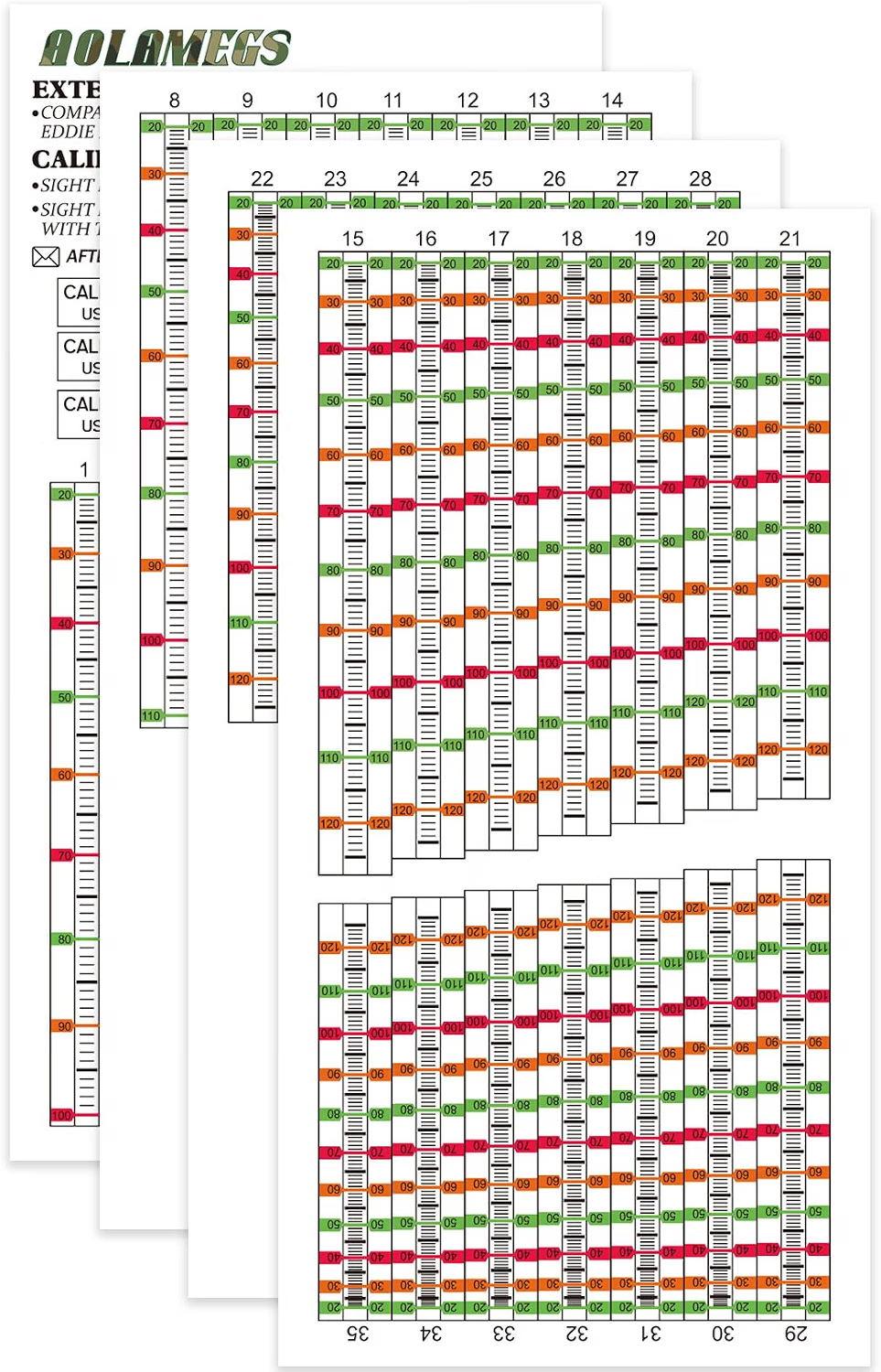
The Archery Sight Tape from 20 to 100/120 Yards associated with the supplied Amazon listing is designed around this concept. The product is described as an extended sight tape with a calibration scale intended for adjustable archery sights and longer-distance applications.
Sight tapes are relatively simple accessories, but understanding how they work requires some knowledge of bow sights, arrow trajectory, distance scales, and equipment consistency. A sight tape does not independently calculate an arrow’s trajectory, and a printed distance scale should not be assumed to work identically on every bow.
Factors such as bow configuration, arrow characteristics, draw weight, draw length, sight geometry, environmental conditions, and individual shooting consistency can affect the relationship between a sight’s position and a particular distance.
For that reason, sight tape systems are best understood as reference tools for a particular archery setup, rather than universal distance charts.
This article explains the purpose of an archery sight tape, how calibration scales work conceptually, what the 20-to-100/120-yard range represents, how sight tapes compare with other distance-reference systems, and what archers should consider before selecting or using one.
The focus is on equipment education and safe recreational archery rather than instructions for improving weapon accuracy.
Key Features
Extended Distance Scale
The main feature of this type of product is its extended distance range.
The product is described as covering distances from approximately 20 yards through 100 or 120 yards, depending on the selected scale and configuration.
A longer scale can be useful for archers who use adjustable sights across a wider range of target distances.
Distance markings provide a visual reference rather than changing the physical behavior of the bow.
The tape itself does not alter arrow speed, trajectory, or sight movement. It simply provides a graduated reference that can correspond to different positions of an adjustable sight.
Calibration Scale
A calibration scale is useful because an adjustable bow sight needs some way to relate its physical position to a known distance.
Without a scale, an archer may need to remember positions or rely on visual estimation.
A sight tape introduces a repeatable reference.
The markings can represent different distance values, allowing the archer to associate the position of the sight mechanism with the corresponding distance for that particular equipment configuration.
The important word is calibration.
A sight tape is not necessarily accurate simply because the printed numbers are correct mathematically. The relationship between those numbers and a particular bow depends on how the bow and sight interact.
Long-Range Reference
The inclusion of markings extending toward 100 or 120 yards distinguishes an extended sight tape from shorter-range references.
Long-distance archery can involve considerably different equipment and environmental considerations from ordinary short-range practice.
At greater distances, small differences in equipment setup, arrow flight, wind, and consistency can become more noticeable.
An extended sight tape therefore functions primarily as a reference system for archers whose equipment and permitted activity involve longer distances.
Designed for Adjustable Sights
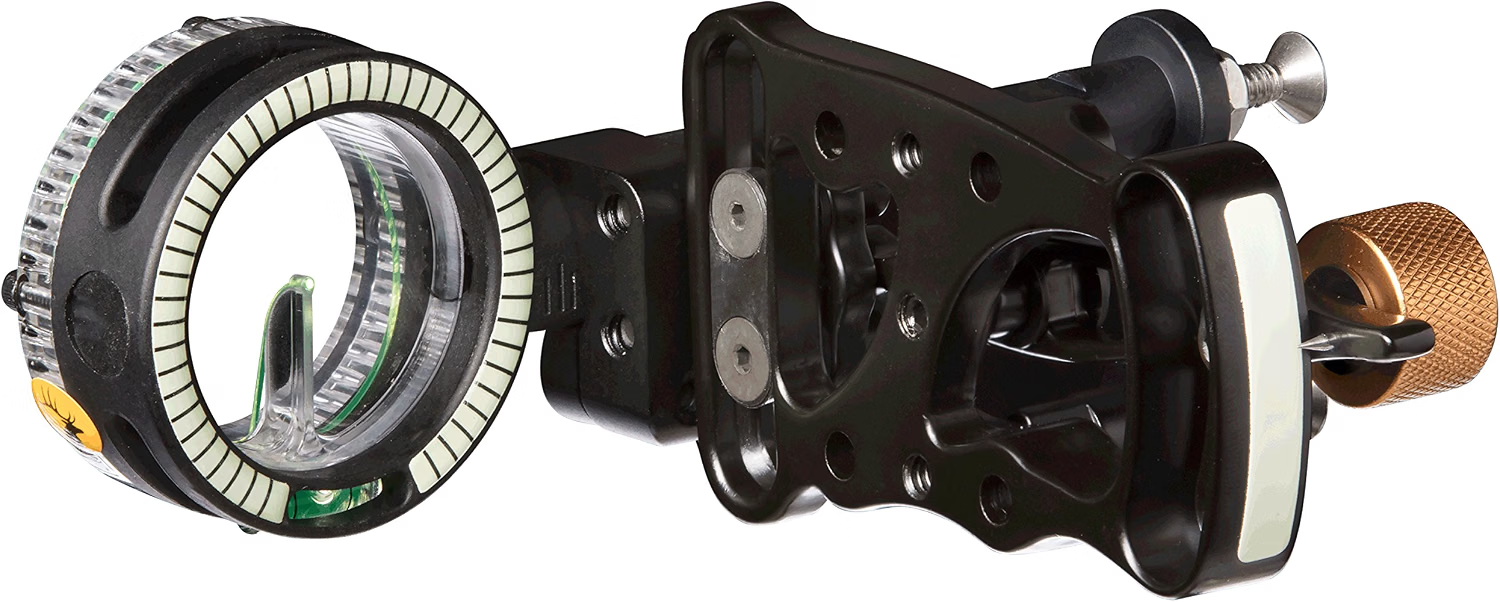
Sight tapes are particularly relevant to slider-style or movable bow sights.
An adjustable sight changes position along a graduated scale.
The tape gives that movement a distance-related reference.
This is different from a fixed multi-pin sight, where several pins remain in predetermined positions.
A sight tape is therefore closely associated with the concept of a movable sight housing or sight pin.
Compact Accessory
Sight tape is generally a small accessory compared with the bow, sight housing, stabilizer, or other archery equipment.
Its compact format makes it relatively easy to store with other archery accessories.
Because sight tape is a reference material rather than a large mechanical component, its physical condition is also important. Folding, tearing, moisture, dirt, or adhesive failure can make the markings more difficult to read.
What Is an Archery Sight Tape?
An archery sight tape is a marked strip used with an adjustable bow sight.
The basic idea is similar to a measuring scale.
Instead of measuring centimeters or inches, the markings represent archery distances.
For example, a tape might contain references such as:
- 20 yards
- 30 yards
- 40 yards
- 50 yards
- 60 yards
- 70 yards
- 80 yards
- 90 yards
- 100 yards
Some extended tapes continue farther.
The actual spacing between distance markings is not necessarily uniform.
This is important.
Arrow trajectory is not a straight-line relationship with distance, so the physical distance between sight positions can change as the sight moves through its range.
A sight tape is therefore designed around the relationship between the adjustable sight and the trajectory of the specific equipment configuration.
Why Calibration Matters
A bow does not send an arrow along a perfectly flat path.
Gravity affects the arrow immediately after it leaves the bow.
Arrow speed, drag, weight, shape, and other factors influence its flight.
The bow itself also has characteristics that influence the trajectory.
For this reason, a printed distance scale cannot automatically be treated as universally accurate for every bow.
A sight tape is more accurately understood as part of a calibrated equipment system.
The tape corresponds to the sight’s physical movement, while the sight’s position corresponds to the trajectory characteristics of the bow and arrow configuration.
Change the equipment significantly, and the relationship can change.
How It Can Be Used
Because sight tapes relate to adjustable archery sights, the safest way to describe their use is at a general equipment level rather than providing a detailed procedure for optimizing a weapon’s accuracy.
Adjustable Bow Sight Systems
The most obvious application is an adjustable bow sight.
A slider-style sight can move through different positions.
A sight tape provides a numerical reference for those positions.
This allows an archer to understand the relationship between the sight’s mechanical position and a distance value.
Target Archery Equipment
Sight tapes can be relevant to target archers using compatible adjustable sights.
Target archery involves clearly defined distances and controlled environments, making distance references particularly useful as part of equipment organization.
The exact equipment permitted depends on the rules of the governing organization and competition category.
Recreational Practice
For recreational archery, a sight tape can provide a convenient way of organizing distance references.
An archer can use the markings as part of a consistent setup rather than relying entirely on memory.
Outdoor Archery
Outdoor conditions can involve different target distances and environmental variables.
A sight tape provides a mechanical reference, although it does not compensate automatically for wind, elevation changes, temperature, or other environmental factors.
Equipment Documentation
A sight tape can also serve as a simple record of an established equipment configuration.
If an archer uses a particular bow, arrow setup, and sight configuration consistently, the scale can become a convenient visual record of the corresponding sight positions.
Significant changes to the equipment may require the reference to be reconsidered.
Who It May Be Suitable For
Archers Using Slider Sights
Sight tape is primarily relevant to archers whose sights can be adjusted through a range of positions.
A fixed sight with no movable scale may have little practical use for this type of accessory.
Target Archers
Archers participating in target disciplines with adjustable sights may find distance references useful for organizing equipment settings.
Recreational Archers
A sight tape can also be useful for recreational archers who want a clear distance reference on a compatible adjustable sight.
Archers Practicing at Different Distances
A longer sight tape can be relevant to users whose permitted practice environment includes a wider range of target distances.
Archers Maintaining Consistent Equipment
A sight tape becomes more useful when the bow and arrow setup remain relatively consistent.
Frequent changes to arrows, draw weight, sight position, or other major equipment characteristics can change the relationship represented by the tape.
Important Things to Consider
Sight Tape Is Not Universal
This is perhaps the most important point.
A tape marked from 20 to 120 yards does not mean that the same sight position will correspond to 60 yards on every bow.
The scale is a reference associated with a particular equipment configuration.
Bow Setup Matters
The following factors can influence trajectory:
- Draw weight
- Draw length
- Arrow mass
- Arrow diameter
- Arrow length
- Fletching
- Bow efficiency
- Release consistency
- Sight geometry
A change in one or more of these characteristics can affect the relationship between sight position and distance.
Sight Geometry Matters
The physical position of the sight relative to the bow and arrow also influences how much the sight needs to move for a particular change in distance.
Two bows can use the same sight but have different sight-to-arrow geometry.
That means a tape that corresponds well to one configuration may not transfer directly to another.
The Tape Must Be Read Clearly
Small markings can become difficult to distinguish when the tape is dirty, damaged, poorly illuminated, or installed in a location that is difficult to view.
Clear numerical markings are important for a reference accessory.
Adhesive Condition Matters
Many sight tapes are designed to remain attached to a sight.
Adhesive performance can be affected by:
- Moisture
- Dirt
- Temperature
- Surface contamination
- Repeated handling
- Age
The sight surface should be suitable for the tape according to the manufacturer’s instructions.
Protect the Tape From Moisture
Paper or adhesive-backed materials can be affected by prolonged moisture.
If the tape becomes damaged or the markings become unreadable, it may no longer provide a reliable reference.
Long-Distance Markings Require Appropriate Conditions
A tape extending to 100 or 120 yards does not mean that every archer should practice at those distances.
Archery should always be conducted at an appropriate range with a suitable backstop and according to local rules.
Longer distances require an appropriate environment and sufficient safety precautions.
Sight Tape Versus Fixed Multi-Pin Sight
These are two different approaches to distance references.
Sight Tape and Slider
A slider sight uses one primary aiming reference that changes position.
The tape provides a numerical distance scale.
Potential characteristics include:
- One primary aiming reference
- Movable sight position
- Graduated distance reference
- Relatively uncluttered sight picture
The tradeoff is that the sight position must correspond to the intended distance.
Fixed Multi-Pin Sight
A multi-pin sight uses several fixed reference points.
Each pin may correspond to a different distance.
Potential characteristics include:
- Multiple visible distance references
- No need for a movable sight housing
- Familiar fixed-pin format
- More visual elements within the sight picture
Neither system is universally appropriate.
The choice depends on the archer’s equipment, discipline, preferences, and range conditions.
Sight Tape Versus Digital Rangefinding Systems
Another category of distance-reference equipment uses electronics.
A digital rangefinder can provide an estimated distance to a target.
A sight tape is fundamentally different.
It is a physical reference attached to an adjustable sight.
Sight Tape
- Passive
- Lightweight
- No electronics
- Integrated with the sight
- Requires appropriate calibration
Electronic Rangefinder
- Electronic
- Requires power
- Provides distance information through an electronic display
- May use optical or laser-ranging technology depending on the device
The two technologies address different parts of the equipment process.
A sight tape does not measure distance automatically.
Sight Tape Versus Printed Distance Cards
Some archers may keep a separate distance chart or reference card.
A separate card can be easy to replace or update.
However, it is not physically integrated with the sight mechanism.
A sight tape places the distance scale directly alongside the adjustable sight.
This can make the relationship between the scale and sight position easier to understand.
Understanding Distance Scales
A sight tape’s markings should not be interpreted like a standard ruler.
The distance values represent an association between the sight position and a target distance.
The physical spacing between numbers can vary.
For example, the difference between 20 and 30 yards on a sight tape may occupy a different amount of physical space from the difference between 90 and 100 yards.
That is a normal consequence of the trajectory relationship.
Why Arrow Speed Matters
Arrow speed is one factor affecting trajectory.
A faster arrow generally spends less time traveling through the air, while a slower arrow is influenced by gravity for a longer period during flight.
However, speed alone does not determine the complete trajectory.
Arrow mass, aerodynamic characteristics, bow efficiency, and other variables also contribute.
This is another reason why sight tapes should be considered equipment-specific reference materials.
Why Arrow Changes Can Matter
Changing arrows can alter the relationship represented by a sight tape.
Differences can include:
- Overall arrow mass
- Shaft diameter
- Length
- Point weight
- Fletching
- Spine
- Balance
Even if two arrows appear similar externally, their flight characteristics may differ.
An archer who changes to a significantly different arrow setup should not automatically assume that an existing sight tape remains an exact reference.
Environmental Factors
A sight tape provides a distance reference, but it does not measure or automatically compensate for environmental conditions.
Wind
Wind can influence arrow flight.
A sight tape does not contain wind information.
Temperature
Temperature can affect equipment and environmental conditions.
The effect may be relatively small in some situations but more noticeable across broader conditions.
Elevation
Shooting at an angle changes the relationship between the horizontal distance and the actual path traveled.
A basic distance marking does not automatically account for every environmental or geometric variable.
Lighting
Lighting does not generally change the printed distance, but it can affect how easily the tape can be read.
Installation and Compatibility Considerations
A sight tape is useful only if it is compatible with the sight’s physical scale and layout.
Before applying any tape, users should consider:
- Available mounting surface
- Scale orientation
- Tape dimensions
- Adhesive compatibility
- Visibility of markings
- Movement of the sight mechanism
The tape should not interfere with moving components.
It should also remain readable during normal operation.
The manufacturer’s instructions for the specific sight should take priority over generic installation advice.
Maintenance and Care
Keep the Tape Clean
Dust and dirt can obscure small numbers.
A soft, dry cleaning method should be used where appropriate.
Avoid harsh chemicals that could damage printed markings or adhesive.
Avoid Unnecessary Contact
Repeated rubbing or handling can gradually wear printed markings.
The tape should be treated as a reference label rather than a surface intended for frequent contact.
Protect Against Moisture
If the tape becomes wet, allow it to dry according to the material manufacturer’s recommendations.
Do not assume that all adhesive-backed tapes are waterproof.
Replace Damaged Tape
A torn or unreadable tape should not be relied upon as a precise reference.
Replacement is generally more sensible than trying to reconstruct missing markings.
Why Calibration Should Be Treated as Equipment-Specific
A calibration scale represents a relationship.
That relationship is determined by the equipment configuration.
Imagine two bows with identical sight models but different arrow setups.
The sights may physically move through the same range.
However, the sight position associated with a particular distance can differ because the arrows and bows do not produce identical trajectories.
This is a fundamental reason that sight tapes are not simply universal distance rulers.
Storage and Transport
A sight tape is small enough to transport easily, but the adhesive surface and printed markings should be protected.
When storing an archery sight or related equipment:
- Keep it dry
- Avoid excessive heat
- Protect the tape from abrasion
- Prevent other equipment from rubbing against the markings
- Keep replacement references in a clean location
If the tape becomes damaged during transport, the condition should be checked before relying on its markings.
Common Problems
The Numbers Are Difficult to Read
This can happen because of dirt, poor lighting, wear, or small print.
Keeping the tape clean and choosing a suitable mounting position can help.
The Tape Starts Peeling
Possible causes include moisture, dirt, an unsuitable surface, or age.
The surface should be clean and appropriate before applying replacement tape.
The Sight Position Does Not Match the Expected Distance
This does not necessarily mean the tape is defective.
It can indicate that the tape is not calibrated for the current equipment configuration.
Changes to the bow, arrows, sight geometry, or other equipment can affect the relationship.
The Tape Becomes Damaged
A damaged tape should be replaced rather than treated as an exact reference.
The Sight Has a Different Scale
Not every slider sight uses the same physical scale or mounting arrangement.
The tape should be appropriate for the particular sight.
Understanding 100- and 120-Yard References
A sight tape that extends to 100 or 120 yards provides a relatively long numerical range.
However, the presence of these markings does not mean that every bow setup will physically have enough sight travel to reach every listed distance.
The usable range depends on:
- Sight design
- Bow setup
- Arrow configuration
- Sight mounting position
- Available mechanical travel
- Individual equipment characteristics
Long-range markings are therefore best understood as available reference values rather than a promise that every setup will use the entire scale.
Frequently Asked Questions
What is an archery sight tape?
An archery sight tape is a marked strip used with an adjustable bow sight to provide distance-related reference markings.
What distances does this type of tape cover?
The product is described as providing a range from approximately 20 yards through 100 or 120 yards.
The exact usable range depends on the particular tape section and compatible sight configuration.
Is a sight tape universal?
No.
A sight tape is associated with a particular bow, arrow, sight, and equipment configuration.
What is the purpose of the calibration scale?
The scale provides a reference connecting the physical position of an adjustable sight with distance markings.
Does the tape measure distance?
No.
A sight tape does not measure distance automatically.
It is a reference scale.
Does it work with fixed-pin sights?
Sight tapes are primarily intended for adjustable or slider-style sights.
A fixed multi-pin sight generally uses its own fixed distance references instead.
Does a sight tape require batteries?
No.
A conventional sight tape is a passive physical accessory.
Can it be used at 100 yards?
The product is described as extending to approximately 100 yards and potentially 120 yards depending on the scale.
Whether a particular bow and sight can use the full range depends on the equipment configuration and available sight travel.
Can it be used at 120 yards?
The product description identifies an extended range reaching up to approximately 120 yards.
Actual use at that distance depends on the compatible sight, bow setup, range conditions, and applicable safety rules.
Does the tape make a bow more accurate?
No.
The tape is a reference tool.
Accuracy and consistency depend on the complete archery system, including the bow, arrows, sight, shooting technique, and environmental conditions.
Why does the tape need calibration?
Because different bows and arrows produce different trajectories.
Calibration establishes the relationship between the sight’s position and the distance markings for the particular equipment configuration.
Will the same tape work on another bow?
Not necessarily.
A tape calibrated for one setup may not correspond exactly to another setup.
Can changing arrows affect the tape?
Yes.
Changing arrow characteristics can alter the relationship between sight position and distance.
Does draw weight affect a sight tape?
Changes in bow configuration, including draw weight, can affect arrow speed and trajectory and may therefore affect the relationship represented by a sight tape.
Does arrow weight matter?
Yes.
Arrow mass is one factor that can influence trajectory.
Does wind affect the tape?
A sight tape does not automatically compensate for wind.
It provides a distance reference, while environmental factors may require separate consideration.
Is a sight tape the same as a rangefinder?
No.
A rangefinder is an electronic or optical device designed to estimate distance.
A sight tape is a passive reference attached to an adjustable sight.
Is a sight tape better than a multi-pin sight?
These systems work differently.
A slider with sight tape provides one movable reference, while a multi-pin sight provides several fixed references.
The appropriate system depends on the archer’s equipment and preferences.
Can sight tape be reused?
That depends on the tape’s adhesive and the condition of the material.
Removing and repositioning adhesive-backed material can reduce adhesion or damage the tape.
Can the tape get wet?
Some materials may tolerate limited moisture, but users should follow the product’s material specifications rather than assuming that every sight tape is waterproof.
What happens if the markings become damaged?
The tape should be replaced if important markings become unreadable.
Can a sight tape interfere with the sight?
It should not interfere with the mechanical movement of the sight.
The mounting position should be selected according to the sight manufacturer’s instructions.
What should be checked before using a sight tape?
Check that the tape is compatible with the sight, the markings are readable, the tape is securely attached, and the equipment configuration has not changed substantially.
Is a 20-to-120-yard tape suitable for every archer?
No.
The useful range depends on the archer’s equipment, discipline, practice environment, and the mechanical travel of the sight.
Is long-range archery safe everywhere?
No.
Archery should only be practiced at an appropriate range or controlled location with a suitable backstop and according to local laws and range rules.
Conclusion
The Archery Sight Tape described in the supplied Amazon listing is a simple but useful category of accessory for adjustable bow sights. Its purpose is to provide a graduated distance reference, with the listed design covering approximately 20 through 100 or 120 yards.
The most important thing to understand about a sight tape is that it is not a universal ruler.
Its markings represent a relationship between the position of an adjustable sight and a particular bow-and-arrow configuration. Factors such as arrow characteristics, bow setup, sight geometry, and equipment changes can alter that relationship.
This is why calibration is central to the concept.
A properly selected sight tape can make an adjustable sight easier to understand and provide a convenient physical reference for different distance settings. It can also help keep an equipment configuration organized, particularly for archers who regularly work with an adjustable slider sight.
At the same time, a sight tape does not automatically account for wind, temperature, angle, or other environmental conditions. Nor does the presence of markings extending to 100 or 120 yards mean that every bow and sight combination can use the entire range.
Compared with fixed multi-pin sights, a sight tape is associated with a different approach to distance references. A slider provides one movable aiming reference, while a multi-pin sight provides several fixed references. Digital rangefinders represent another category altogether because they actively estimate distance rather than displaying a passive scale.
For anyone evaluating an extended archery sight tape, the most important considerations are compatibility, calibration, readability, durability, and consistency of the underlying bow setup.
The tape itself is only one part of the system. Its usefulness depends on the sight it is attached to and the equipment configuration represented by its markings.
As with all archery equipment, safe practice remains essential. Longer-distance archery should be conducted only in a controlled environment with an appropriate target and backstop, following applicable range rules and local requirements.
For archers using compatible adjustable sights, a calibrated distance tape can provide a straightforward physical reference that complements the mechanical design of a slider sight.