Introduction
Compact laser sights have become a recognizable category of accessory for equipment that uses standardized accessory rails. Compared with larger combination units that integrate a light, laser, and other electronics, a laser-only design can focus on providing a single illuminated reference while keeping the overall accessory relatively small.
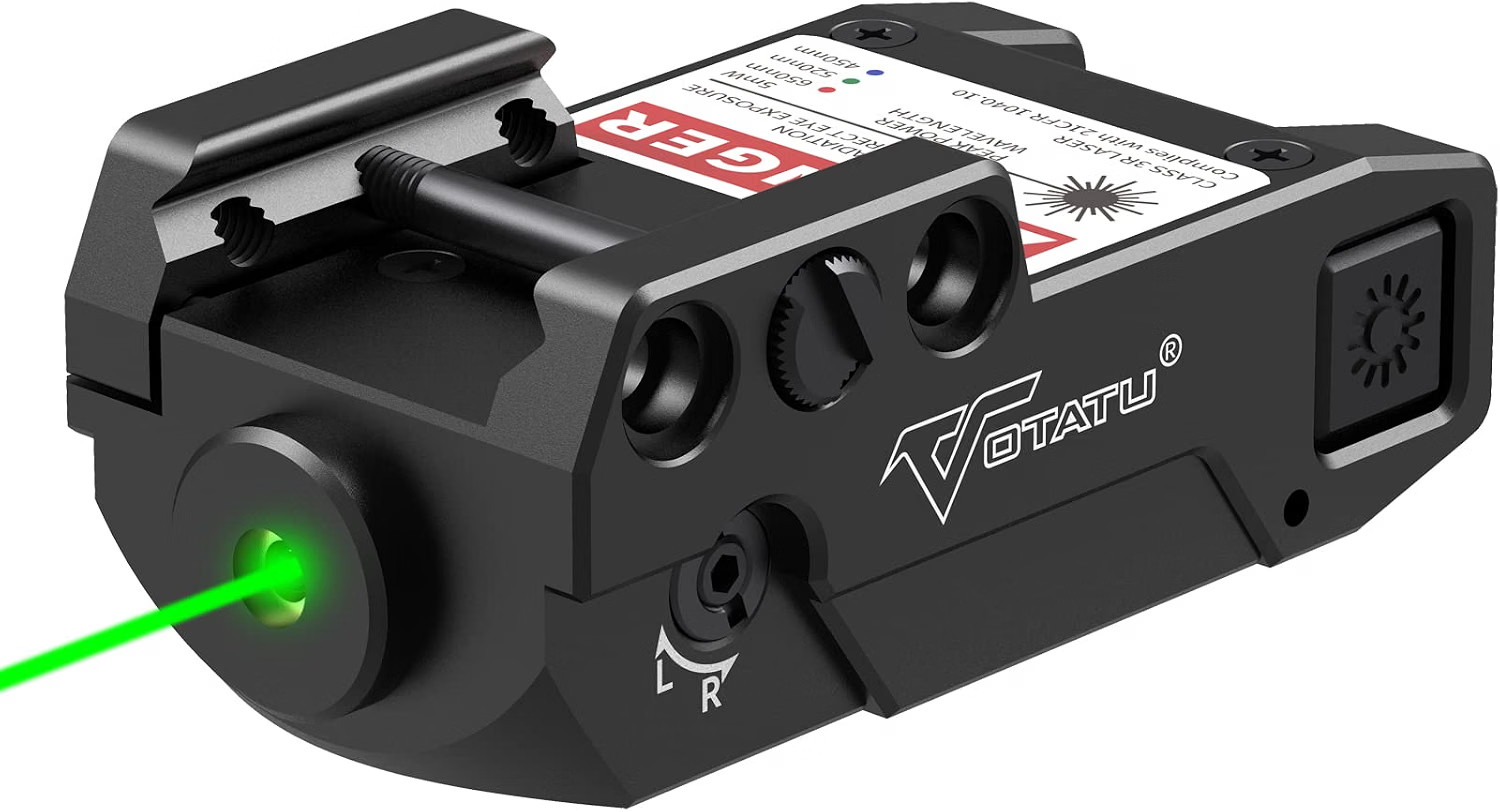
The H3L-G Green Laser Sight for Pistol Rail Mount is a compact laser accessory from VOTATU designed around an ultra-low-profile Picatinny mounting system. The manufacturer identifies the H3L-G as a green laser with a 520 nm wavelength, a maximum output of 5 mW, an aluminum housing, ambidextrous controls, and a built-in rechargeable battery. It uses magnetic USB charging rather than a conventional removable battery.
The product is also described as having an IPX4 water-resistance rating, a weight of approximately 52 grams, and dimensions of about 59 × 33 × 22.5 mm. Product documentation identifies an approximate charging time of 1.5 hours and a stated operating time of around two hours, although actual battery performance can vary according to operating conditions and usage.
One of the main ideas behind this design is minimizing the amount of equipment attached to a compatible rail. Its compact construction can be relevant when physical clearance and accessory size are important considerations.
At the same time, a laser is an optical safety device that requires responsible handling. A visible laser should never be intentionally directed toward a person’s eyes, aircraft, vehicles, or reflective surfaces. The manufacturer specifically warns against direct exposure to the beam and against viewing the beam through optical instruments.
This article examines the H3L-G as a piece of accessory equipment. It explains the meaning of its main specifications, the characteristics of green laser technology, the role of the Picatinny interface, rechargeable power, ambidextrous controls, low-profile construction, maintenance considerations, and the differences between common laser-sight categories. It does not provide instructions for aiming or operating a firearm.
Key Features
Green 520 nm Laser
The defining feature of the H3L-G is its green laser.
The manufacturer specifies a wavelength of 520 nm.
Wavelength describes the physical characteristics of the light being emitted and is closely related to its perceived color.
A 520 nm laser appears green to the human eye.
Green light can appear highly noticeable to many people under suitable conditions, although perceived visibility depends on factors such as ambient lighting, atmospheric conditions, background color, distance, and individual vision.
The presence of a green laser should therefore be understood as a visibility characteristic rather than a guarantee of a particular practical range.
Class IIIA Laser Classification
Available product specifications identify the H3L-G as a Class IIIA green laser with a maximum output of up to 5 mW.
Laser classification is important because it provides information about the potential hazards associated with the emitted light.
Even when a visible laser is relatively compact and low powered compared with industrial or scientific laser systems, it should never be treated as harmless.
The manufacturer’s safety guidance states that users should not look directly into the beam, point the laser at people, direct it toward reflective surfaces, or view it through instruments such as binoculars or microscopes.
These precautions are particularly important because optical instruments can concentrate light and increase exposure to the eye.
Ultra-Low-Profile Housing
The H3L-G is designed around a compact, low-profile form.
VOTATU describes the unit as ultra-compact and low profile, with the intention of minimizing the physical footprint of the accessory on compatible equipment.
This type of design can be useful where accessory height and available clearance matter.
A smaller housing can also make storage and transportation easier.
However, low profile does not automatically mean universal compatibility. The physical relationship between a rail, trigger guard, holster, and other equipment still needs to be checked carefully.
Aluminum Construction
The manufacturer identifies aluminum and an anodized finish as the construction materials for the H3L-G.
The product is described as being machined from high-strength aircraft aluminum.
Aluminum is commonly used in compact accessories because it offers a combination of structural rigidity and relatively low weight.
The material itself should not be interpreted as a guarantee that the device cannot be damaged. Impacts, incorrect mounting, excessive environmental exposure, and normal wear can affect any electronic accessory.
Ambidextrous Controls
The H3L-G uses an ambidextrous control arrangement.
This means the controls are designed to be accessible from either side rather than being dedicated exclusively to left- or right-handed operation.
Ambidextrous controls can be particularly useful on compact accessories because they avoid making the product dependent on one particular hand orientation.
The manufacturer specifically identifies ambidextrous control as one of the H3L-G’s features.
Built-In Rechargeable Battery
Instead of relying on a conventional disposable battery, the H3L-G incorporates a rechargeable battery.
Product specifications identify a built-in polymer battery.
This design eliminates the need to remove a small replaceable battery every time the device needs to be recharged.
It also means that the battery is integrated into the accessory rather than being an easily swapped standard cell.
That distinction is worth considering when thinking about long-term maintenance and storage.
Magnetic USB Charging
The H3L-G uses a magnetic USB charging connection.
According to the manufacturer, the supplied charging cable attaches magnetically to the charging point without requiring the accessory to be removed from its mounting position.
This can be convenient in a compact accessory because the user does not necessarily need to remove the device simply to connect its charging cable.
The manufacturer lists approximately 1.5 hours as the charging time under its stated specifications.
IPX4 Water Resistance
The H3L-G is listed with an IPX4 water-resistance rating.
IP ratings describe protection against particular environmental conditions.
IPX4 indicates protection against water splashes from various directions under the relevant testing conditions.
It should not be interpreted as meaning that the device is waterproof for immersion.
Users should still avoid unnecessary exposure to water and follow the manufacturer’s care instructions.
Lightweight Construction
The listed weight is approximately 52 grams, or about 1.83 ounces.
Weight can be important for accessories attached to compact equipment.
A lighter accessory adds less overall mass than a larger multi-function unit.
The physical dimensions are listed at approximately 59 × 33 × 22.5 mm, or about 2.3 × 1.3 × 0.9 inches.
These dimensions provide a useful reference when evaluating available clearance.
Understanding Green Laser Technology
A laser differs from an ordinary LED because it produces a highly concentrated and directional beam.
The H3L-G uses green light at 520 nm.
The perceived brightness of a laser is influenced by several factors.
Ambient Light
A laser point can be easier to see against some backgrounds than others.
Bright daylight can make any projected light source more difficult to distinguish.
Lower ambient light may make the beam or projected point appear more noticeable, but this does not mean the laser should be used in darkness without considering its safety implications.
Background
A green point can have different visual contrast depending on the color and texture of the surface on which it appears.
A neutral or dark background may provide a different visual contrast from a bright or reflective surface.
Human Vision
People do not all perceive colors identically.
Visual sensitivity can vary between individuals.
The green wavelength used by the H3L-G is within the visible spectrum, but perceived brightness should not be assumed to be identical for every person.
How It Can Be Used
Because the H3L-G is a weapon-related laser accessory, this section focuses on general equipment categories and compatibility rather than providing operational instructions.
Compatible Rail-Based Equipment
The H3L-G is designed around a Picatinny-style mounting interface.
The manufacturer describes compatibility with standard rail-equipped pistols as well as rifles and shotguns using modern M1913-style accessory rails.
Actual compatibility depends on the physical dimensions of the equipment.
Airsoft
The H3L-G is also marketed for airsoft applications.
A compact green laser can be used as an accessory on compatible airsoft platforms where the field permits lasers.
Airsoft venues can have their own restrictions concerning lasers, power, eye protection, and accessories, so the rules of the particular venue should always be checked.
Recreational Equipment
Other sporting or recreational equipment may incorporate Picatinny-style rails.
A compatible accessory can potentially be mounted where the equipment manufacturer permits it.
The rail standard should always be verified rather than assuming that visually similar mounting slots are interchangeable.
Equipment Familiarization
The H3L-G can also be considered as an example of compact laser technology.
For people studying optics or accessory design, its specifications provide a practical example of how wavelength, power, mounting interfaces, battery systems, and environmental protection come together in a small electronic product.
Who It May Be Suitable For
Users Seeking a Compact Laser Accessory
The H3L-G is designed around a relatively small housing.
It may be relevant to users who want a laser accessory without adding a larger light-and-laser combination unit.
Users With Compatible Picatinny Rails
The mounting system is intended for Picatinny-style accessory rails.
Users with compatible equipment can evaluate the dimensions and clearance before considering the accessory.
Users Who Prefer Rechargeable Equipment
The integrated rechargeable battery eliminates the need to purchase and install conventional disposable batteries.
For users who already use USB charging equipment, the magnetic charging approach may fit naturally into an existing maintenance routine.
Users Who Need Ambidextrous Controls
Ambidextrous controls provide accessibility from either side of the housing.
This can be useful for equipment configurations where control access needs to remain flexible.
Recreational Airsoft Users
The product is identified for airsoft among its intended applications.
Airsoft users should verify field rules before using any laser accessory.
Important Things to Consider
Verify Rail Compatibility
A Picatinny mount should be used only with a compatible rail.
Although many accessories use similar-looking mounting systems, dimensions and slot geometry can differ.
The H3L-G product information specifically refers to standard Picatinny/M1913-style accessory rails.
Check Physical Clearance
Product listings indicate that the compact pistol configuration is intended for rail-equipped pistols with sufficient clearance between the mounting area and trigger guard. Some listings identify a clearance requirement greater than approximately 1.39 inches.
This is an important example of why compatibility should be checked using measurements rather than appearance alone.
Consider Holster Compatibility
A low-profile accessory may occupy less space than a larger laser or light.
However, a holster designed for a particular handgun without an accessory may not accommodate the added device.
Holster compatibility must be checked specifically for the firearm-and-accessory combination.
Where a firearm is carried, the holster should provide appropriate protection around the trigger area and be designed for the exact configuration.
Understand the Difference Between Water Resistant and Waterproof
IPX4 does not mean that the device can be submerged.
The rating relates to splashing water.
The accessory should not be intentionally immersed unless the manufacturer explicitly provides a different specification.
Rechargeable Batteries Have a Lifecycle
Built-in rechargeable batteries are convenient, but they are not indefinitely reusable.
Rechargeable cells gradually lose capacity over time.
Battery longevity can depend on charging habits, temperature, storage conditions, and frequency of use.
Charging Cable Availability
Because the H3L-G uses a proprietary magnetic charging arrangement, losing the charging cable can be more inconvenient than losing a generic USB cable.
Keeping the supplied charging cable in a designated location can help avoid this problem.
Do Not Rely on Claimed Maximum Visibility
Some product listings state that the green laser can be visible to very long distances under favorable conditions.
Such figures should not be interpreted as guaranteed practical performance.
Visibility varies substantially with daylight, atmospheric conditions, background, beam divergence, eye sensitivity, and other environmental factors.
Laser Safety
The most important consideration is safe handling of the laser.
The manufacturer explicitly warns:
- Never look directly into the laser beam.
- Never point the laser at people.
- Never point it at reflective surfaces.
- Never view the laser through binoculars or microscopes.
- Keep children from using the laser without close adult supervision.
These warnings should be treated as fundamental operating requirements.
Follow Local Regulations
Laser devices and firearm accessories can be regulated differently across jurisdictions.
Rules may apply to the possession, transportation, use, or power level of laser devices.
Users should verify the regulations applicable to their location and intended activity.
Low-Profile Laser Versus Larger Laser Modules
Laser accessories come in different physical formats.
Ultra-Low-Profile Designs
The H3L-G emphasizes compact dimensions and low height.
Potential benefits include:
- Lower overall accessory footprint
- Reduced added weight
- Less interference with surrounding equipment
- Potentially easier storage
The exact advantage depends on the platform and accessory configuration.
Larger Laser Modules
Larger units may provide more room for controls, batteries, or additional electronics.
Some products combine a laser with a flashlight.
That can increase functionality but also increases physical size.
The appropriate category depends on the user’s requirements and the equipment’s available space.
Laser-Only Versus Light-and-Laser Systems
The H3L-G is primarily a laser accessory.
Another common category combines a visible light with a laser.
Laser-Only Design
The main focus is the laser.
This can allow a relatively small housing.
Light-and-Laser Design
A combination device can add illumination capability.
However, adding an LED light, reflector, battery system, and associated electronics generally requires additional physical space.
The choice between the two categories is therefore partly a question of whether illumination is required.
Rechargeable Versus Replaceable-Battery Laser Sights
Rechargeable
The H3L-G uses a built-in rechargeable battery and magnetic USB charging.
Advantages can include:
- No routine disposable battery replacement
- Convenient USB charging
- No need to remove a small battery during normal charging
The tradeoff is that the battery is integrated into the device.
Replaceable Battery
A replaceable-battery design allows the user to carry spare batteries.
This can be useful where immediate replacement is more convenient than recharging.
The tradeoff is that compatible batteries need to be kept available.
Green Versus Red Lasers
Laser sights are available in several colors, most commonly red and green.
The H3L-G uses green light at 520 nm.
Green Lasers
Green wavelengths can appear highly visible to the human eye under many conditions.
However, visibility depends heavily on the environment.
Red Lasers
Red lasers generally operate at longer wavelengths and are also widely used.
They can consume different amounts of power depending on the laser technology.
Neither color should be considered universally superior.
The choice involves visibility, power requirements, environment, and personal visual perception.
Understanding IPX4 Protection
The H3L-G’s IPX4 rating is useful for understanding its environmental limitations.
IPX4 relates to protection from splashing water.
It does not mean:
- Safe for underwater use
- Safe for prolonged heavy rain without limitation
- Safe for pressure washing
- Safe for immersion
Users should dry the device after significant moisture exposure and follow the manufacturer’s maintenance recommendations.
Maintenance and Care
Keep the Lens Clean
If the laser aperture becomes dirty, the emitted beam can be affected.
Use suitable cleaning materials and avoid abrasive surfaces.
Protect the Charging Connection
The magnetic charging interface should be kept clean.
Metal particles or debris around a magnetic connector can interfere with charging.
Inspect the Mount
The mounting area should be periodically inspected for damage.
A damaged mounting interface can compromise the accessory’s physical stability.
Check the Housing
Look for cracks, dents, or deformation.
A compact aluminum housing can be durable, but it is still possible to damage it through significant impact.
Protect the Laser Emitter
The emitter should remain free of dirt and should not be subjected to unnecessary contact.
Never inspect the beam by looking directly into the emitter.
Storage
For extended storage, follow the manufacturer’s recommendations concerning battery charge and environmental conditions.
Keep the device in a dry location away from excessive heat.
Battery and Charging Considerations
The H3L-G uses a built-in polymer battery.
The manufacturer lists magnetic USB charging and approximately 1.5 hours of charging time.
Another product specification lists approximately two hours of operating time.
Actual battery performance can vary.
Factors can include:
- Operating mode
- Temperature
- Battery age
- Charging condition
- Frequency of use
- Electronic control settings
Rechargeable batteries generally perform best when they are not exposed to extreme heat or cold.
General Troubleshooting
The Laser Does Not Turn On
First consider the battery state.
If the device has not been used for an extended period, the battery may require charging.
The charging connection should also be inspected for contamination.
If the device still does not function, the manufacturer’s support information should be consulted.
The Laser Appears Dim
Visibility can change significantly with ambient lighting.
A laser that appears bright indoors can appear less noticeable in strong daylight.
Clean the emitter carefully and verify the battery condition.
Charging Does Not Begin
Check that the magnetic charging connector is properly aligned.
Inspect the charging contacts for dirt or debris.
Use the supplied or manufacturer-approved charging equipment.
The Device Feels Loose
Stop using the accessory until the mounting system has been inspected.
The rail interface and mounting hardware should be checked for damage or improper engagement.
The Beam Is Not Visible
A laser beam is not necessarily visible in every environment.
Airborne particles, background color, ambient lighting, and viewing angle all affect visibility.
Do not attempt to inspect the emitter directly.
Frequently Asked Questions
What is the H3L-G?
The H3L-G is a compact green laser sight manufactured by VOTATU and designed for compatible Picatinny-style accessory rails.
What color laser does it use?
It uses a green laser with a wavelength of 520 nm.
What is the laser’s maximum output?
The manufacturer’s specifications identify a maximum output of 5 mW and a Class IIIA classification.
Does it use a disposable battery?
No. The H3L-G uses a built-in rechargeable polymer battery.
How is it charged?
It uses a magnetic USB charging connection.
How long does charging take?
Available product specifications list approximately 1.5 hours for charging.
How long does the battery last?
The manufacturer-related product information lists approximately two hours of operating time. Actual runtime can vary depending on operating conditions and battery condition.
Is the H3L-G waterproof?
It is listed as IPX4 water resistant.
IPX4 means protection against water splashes under specified test conditions; it does not mean the device is designed for immersion.
Is the control ambidextrous?
Yes. The product is designed with ambidextrous controls.
What type of rail does it use?
The H3L-G is designed for Picatinny/M1913-style accessory rails.
Can it fit every pistol?
No.
The pistol must have a compatible rail and sufficient physical clearance.
Some product information identifies a clearance requirement of more than approximately 1.39 inches between the rail mounting slot and trigger guard for certain compact pistol configurations.
Is it suitable for rifles?
The manufacturer describes compatibility with rifles and shotguns that have appropriate modern accessory rails.
The exact rail dimensions and physical clearance should still be verified.
Is it suitable for airsoft?
The product is marketed for airsoft among its listed applications.
Airsoft fields can have specific rules concerning laser accessories, so those rules should be checked before use.
What does ultra-low profile mean?
It means the accessory is designed to minimize its height and overall physical footprint relative to larger laser or light modules.
How much does the H3L-G weigh?
Available specifications list approximately 52 grams, or 1.83 ounces.
What are its dimensions?
The listed dimensions are approximately 59 × 33 × 22.5 mm, or about 2.3 × 1.3 × 0.9 inches.
Is it made from aluminum?
Yes. The manufacturer identifies aluminum construction with an anodized finish.
Does it have a strobe mode?
Product listings identify a strobe mode as an available feature.
The exact control method should be confirmed in the supplied documentation.
Can the laser be seen at long distances?
Product listings cite visibility figures extending to approximately 200 meters during the day and up to 2,000 meters at night under favorable conditions.
These figures should not be treated as guaranteed real-world visibility because environmental conditions can substantially change how a laser appears.
Is the laser safe to look at?
No.
Users should never look directly into the laser beam. The manufacturer also warns against directing it toward people or reflective surfaces and against viewing it through optical instruments.
Can children use it?
The manufacturer warns that children should not use the laser without close adult supervision.
Does it include a flashlight?
The H3L-G is a laser-focused accessory rather than a combined flashlight-and-laser unit.
Is it a red laser?
No. The H3L-G is the green-laser version and uses a 520 nm wavelength.
What is the difference between a green and red laser?
The main physical difference is wavelength and perceived color.
Green light can appear highly visible to the human eye under many conditions, but practical visibility depends on the environment and individual vision.
Does the H3L-G require a holster?
A holster is not inherently part of the laser itself, but any equipment used with a mounted accessory should be specifically compatible with that configuration.
What should be checked before purchasing?
Check the rail standard, physical dimensions, clearance around the mounting area, holster compatibility where relevant, charging requirements, local regulations, and laser-safety requirements.
Conclusion
The H3L-G Green Laser Sight is designed around a straightforward concept: provide a compact visible laser while keeping the accessory’s physical footprint relatively small.
Its main specifications include a 520 nm green laser, a maximum output of 5 mW, a Class IIIA classification, aluminum construction, ambidextrous controls, a built-in rechargeable battery, magnetic USB charging, and an IPX4 water-resistance rating.
The ultra-low-profile design is particularly relevant for users who need to consider available space around a rail-mounted accessory. At approximately 52 grams and roughly 59 × 33 × 22.5 mm, the unit is designed to remain relatively compact.
Its rechargeable design also changes the maintenance routine compared with a conventional battery-powered laser. Instead of keeping disposable cells available, users need to maintain the built-in battery and retain access to the magnetic charging cable.
Compatibility is another important consideration. The H3L-G is designed around Picatinny/M1913-style rails, but not every firearm or sporting platform provides the same rail dimensions or available clearance. Product information also identifies a specific clearance consideration for certain compact pistol configurations, reinforcing the importance of checking dimensions before installation.
The green 520 nm laser provides a highly visible wavelength under suitable conditions, but published maximum visibility distances should be regarded as environmental-dependent specifications rather than guarantees. Daylight, background color, weather, atmospheric conditions, and human vision can all influence what is actually visible.
Most importantly, the H3L-G is a laser device and should be treated accordingly. The manufacturer warns against direct eye exposure, pointing the laser at people or reflective surfaces, and viewing the beam through optical instruments.
For users evaluating a compact rail-mounted laser, the important factors extend beyond size or color. Mounting compatibility, physical clearance, charging requirements, battery maintenance, environmental protection, and responsible laser handling all contribute to whether this type of accessory is appropriate for a particular application.
Leave a Reply